Terms and definitions you might want to know.
Glossary
Definitions and explanations of key terms.
Jump to a term
A
Advance Health Directive
Advance Health Directive
An Advance Health Directive (AHD) is a legal document that allows an adult in Queensland to give directions about their future health care and special health care.
An AHD is particularly useful if there comes a time when you are unable to make decisions about your health care yourself. The directions in the AHD operate when you do not have capacity to make the relevant health care decision.
You can use an AHD to record your wishes about things such as:
- life-sustaining treatment
- other health care
- blood transfusions
- what is important to you when you are nearing death
- cultural, religious or spiritual preferences
- who you would like involved in discussions about your care.
You can also use an AHD to appoint an attorney for health matters --- someone you trust to make health care decisions for you if you lose capacity.
An AHD is different from an end of life plan. An end of life plan can include many practical and personal wishes, while an AHD is a formal legal document dealing with health care decisions.
Making an Advance Health Directive
The Queensland AHD must be completed by an adult who has capacity to make the document. A doctor must complete the doctor certificate, and the person making the AHD must sign it in the presence of an eligible witness such as a justice of the peace, commissioner for declarations, lawyer or notary public.
Once completed, the original should be kept somewhere safe and relevant people should know that it exists and where it can be found.
An AHD is about your health care choices. It is not a funeral plan, and it is not a way of making a decision about voluntary assisted dying on your behalf.
Alkaline Hydrolysis
Alkaline Hydrolysis
Alkaline hydrolysis is a method of final disposition that uses water, heat and an alkaline solution to break down the organic components of a person’s body. It is sometimes described as water cremation, aquamation or resomation, although these terms can refer to particular technologies or trade names.
How it works. Instead of using a flame and combustion, alkaline hydrolysis places the person in a sealed vessel containing water and an alkaline solution. Heat and pressure accelerate a process that would otherwise take a very long time naturally, breaking down the body’s organic material.
What remains. The process does not simply dissolve everything. The mineral structure of the bones remains. Once the process is complete, the remaining bone material is dried and processed into a fine material in much the same way that bone fragments are processed after conventional cremation. These processed remains are commonly returned to the family as ashes or cremated remains, although the physical process by which they were produced is different.
Different from cremation. Conventional Cremation uses controlled combustion in a Cremator. Alkaline hydrolysis does not use combustion or a cremator. Instead, the body is processed inside a specialised hydrolysis vessel using water, heat and alkaline chemistry.
The result is similar in some important ways. Although the process is different, the purpose is similar: to provide a permanent form of final disposition and leave the family with processed skeletal remains that can be kept, scattered, buried or otherwise cared for.
It uses water rather than flame. Alkaline hydrolysis is sometimes promoted as a lower-emission alternative to flame-based cremation because there is no combustion of the body. The overall environmental impact depends on the particular equipment, energy source, water use and treatment of the resulting liquid.
The liquid is not simply discharged untreated. The process produces a liquid containing the dissolved organic components of the body and the alkaline solution. Appropriate treatment and disposal of this liquid is an important part of any alkaline hydrolysis system and is subject to the requirements of the jurisdiction in which the process operates.
Queensland. Queensland’s current legislation specifically regulates the cremation of human remains and requires permission before a cremation can take place. The legislation separately defines disposal of human remains, including cremation, burial and other permanent resting places. It does not simply define alkaline hydrolysis as cremation.
This means that while alkaline hydrolysis is an established alternative disposition method in some jurisdictions, its availability and legal status depend on the laws and approvals applying where it is to be carried out.
A different technology for a similar purpose. Alkaline hydrolysis is therefore best understood as another way of caring for and reducing human remains after death, rather than simply as a different type of cremator.
Related
Aquamation
Aquamation
Aquamation is a term used for Alkaline Hydrolysis.
Aquamation® is a registered Australian trade mark owned by Little Red Hen Pty Ltd (Australian Trade Mark No. 1612841). The registration covers services including human water cremation, human tissue digestion, water burial and alkaline hydrolysis of humans.
Ashes
Ashes
⚠️ Some of the information in this entry may be disturbing to some readers.
Ashes is the common term used for the material returned to a family after a person has been cremated. The term is familiar and convenient, but cremated remains are not actually ash in the usual sense of the word. They are primarily the mineral remains of the person’s bones, which have been processed into a fine, granular material.
What remains after cremation. During cremation, the body is exposed to very high temperatures. Most of the body’s soft tissue is consumed by the process, but the mineral structure of the bones remains. After the cremation has finished and the material has cooled, what remains is collected for processing.
The bones are processed. The remaining bone fragments are not simply swept up and placed into a container. They are processed in a machine called a cremulator, which reduces the larger bone fragments into the smaller, relatively uniform particles that families commonly recognise as ashes.
They are not really ashes. The resulting material is therefore more accurately described as cremated remains. It is largely made up of processed bone mineral rather than the fine, sooty ash that might be left after burning wood or paper. The familiar term ashes is nevertheless widely used by families, funeral providers and crematoria.
The colour can vary. Cremated remains are usually light grey, white or a combination of the two, although the appearance can vary depending on the person, the cremation process and the equipment used. They may contain small variations in texture and colour because they are the processed mineral remains of the person rather than a manufactured substance.
What happens to the ashes. Once processed, the cremated remains are placed into a secure container and can be returned to the family. They may then be kept at home, placed in an Urn, buried, scattered, divided between family members or otherwise cared for according to the family’s wishes and applicable requirements.
A word that carries meaning. Although cremated remains is the more technically accurate term, many people prefer the word ashes because it is familiar and feels less clinical. There is no need for a family to use one term rather than the other.
What a family receives after cremation is therefore not simply the ash left behind by burning a body. It is the processed mineral remains of the person’s bones — commonly and understandably called their ashes.
Related
B
Births, Deaths & Marriages (BDM)
What Is BDM?
BDM is the abbreviation commonly used for Births, Deaths and Marriages.
In the funeral industry, when someone refers to “BDM”, they are usually talking about the government registry responsible for recording births, deaths and marriages, and particularly the registration of a death and the issuing of death certificates.
The name of the registry varies between Australian states and territories.
- Queensland, New South Wales, Victoria and Western Australia: Registry of Births, Deaths and Marriages
- Tasmania, South Australia and Northern Territory: Births, Deaths and Marriages
- Australian Capital Territory: Births, Relationships and Deaths
Although the official names differ, “BDM” is commonly used as a general shorthand for the relevant state or territory registry.
In Funeral Work
For us, BDM is most often associated with registering a death and completing the paperwork required after someone has died.
BDM is separate from the Coroner. A death may be registered through BDM whether it is a straightforward medical death or a death that has been investigated by the Coroner, although the process and responsibility for registration can differ.
Related
- Cause of Death Certificate (Form 9)
- Death Registration
Body Bag
Body Bag
⚠️ Some of the information in this entry may be disturbing to some readers.
A body bag is a sealed, usually waterproof bag used to contain and transport a person who has died. They are commonly used when a person is transferred from a hospital, the care of a coroner or another facility, particularly where the circumstances of the death require the person to remain contained and identified.
Not always necessary. Body bags are a practical transport and containment product rather than something that must be used for every person who has died. In our practice, we generally avoid using them where circumstances allow. When collecting someone from a private residence, for example, we will often use a sheet or other appropriate covering instead.
Hospital and coroner collections. People collected from hospitals, coroners or similar facilities will commonly already be in a body bag. The type of bag used can vary, including the type of plastic from which it is manufactured. PVC is generally avoided where alternatives are available.
Lightweight and inexpensive. Body bags are generally inexpensive, lightweight products rather than heavy-duty equipment. They need to be handled with some care, particularly when opening and closing the zipper, as the plastic and stitching can be relatively easily damaged.
How the zipper is fitted. A common way of manufacturing a body bag is to first create and seal the bag itself and then sew the zipper onto it. Once the zipper has been attached, the bag can be opened and a blade used to create the actual opening underneath the zipper. This is a simpler manufacturing process than trying to sew the zipper into an already-open bag.
The zipper. Most body bags have a zipper running around the opening, often with two toggles that meet when the bag is closed. The zipper needs to be operated carefully so that the teeth do not catch the plastic or the material around the opening. The sound and feel of the zipper is also one of the practical reasons we prefer not to use body bags where they are unnecessary. What is an ordinary piece of transport equipment in another setting can feel confronting in the context of caring for a person who has died.
A document pocket. Body bags commonly have a pocket for legal or identification documents. This provides a secure place for paperwork that needs to remain with the person during transfer.
Queensland Health identification. When a person is transferred from a Queensland Health facility, they will usually have a patient identification label attached to the person, their clothing and the body bag. These are the familiar labels commonly seen on hospital patients. They contain identifying information such as the person’s name, date of birth, address and Queensland Health patient identification number, helping ensure that the person remains correctly identified throughout their care and transfer.
Police and coronial identification tags. Where a death has been reported to the coroner under Queensland law, the person may arrive with a Police identification tag attached to the body bag. This can remain in place even when the Coroner has determined that an autopsy is not required.
The tag is typically secured with wire, rather than being something that can simply be unclipped. Wire cutters are therefore required to remove it when the person is released into the care of the funeral service provider.
A temporary part of care. A body bag is generally a means of safely containing and identifying a person during transport or while they are in the care of a hospital, police or coroner. It is not intended to be part of the funeral itself. Once the person is in the care of the funeral service provider, they may be transferred into another form of care appropriate to the family’s arrangements.
Related
Booklet
Booklet
A booklet is a printed or digital collection of information, images and other material created for a funeral or memorial. It can be as simple as a single sheet of paper folded in half or as elaborate as a professionally designed publication filled with photographs, stories and personal touches.
A simple keepsake. A booklet does not need to be complicated or expensive. An A4 sheet of paper, printed at home and folded in half, can provide everything a family needs to guide people through a ceremony and give them something to take home.
More than an Order of Service. A booklet may contain the Order of Service, but it can also include much more. Photographs, stories, poems, favourite sayings, a biography, family history, recipes, artwork or other things that say something about the person can all be included.
A chance to personalise the farewell. Families can use the booklet to include things that are particularly meaningful to the person who has died. One booklet might include a favourite poem printed on a textured paper insert. Another might include a crossword created specifically around the person’s life, interests and sense of humour.
A lasting keepsake. Unlike the spoken parts of a funeral, a booklet can be taken home and kept. It can become a small physical reminder of the person and the farewell, particularly when it contains photographs, stories or other personal material.
A place for practical information. The back page is often used to thank family, friends and others who have supported the person or their loved ones. Where a gathering is planned after the funeral, it can also provide an invitation and practical details such as the location, time and any other information guests need to know.
Not every funeral needs one. A booklet is not a legal requirement and many funerals do not have one. Where a ceremony is simple, an Order of Service can be provided separately, or the celebrant can simply guide those gathered through what is happening.
Ultimately, a booklet can be as simple or as personal as the family wants it to be. It is another opportunity to make a funeral reflect the person rather than simply follow a standard format.
Related
Burial
Why is a burial needed?
Public health. A body cannot simply be left unmanaged after death. Burial provides a contained and lawful way of managing decomposition, placing the body below ground and away from ordinary contact.
Legal and civic necessity. In Queensland, as with cremation, a body must be lawfully disposed of. Burial is one of the recognised ways of doing this, with cemeteries providing the infrastructure for the interment of bodies.
Returning the body to the earth. Burial is fundamentally different from cremation in what happens to the body. Rather than using heat to reduce the body to cremated remains, burial allows the body to decompose gradually and return to the earth. For some people, that natural process is an important part of what burial means.
A permanent place. Burial creates a specific physical location: the grave. That place can become a lasting point of connection for family and friends, giving them somewhere to visit, remember and mark the person’s life.
Continuity of tradition. Burial has been practised across cultures and religions for thousands of years. For some families, it is simply the expected or required way of caring for someone who has died. Religious or cultural traditions may also make burial preferable or necessary.
Ritual and participation. Burial provides a visible and physical act of farewell. The lowering of the coffin, the covering of the grave and the later marking of the site can give the funeral a sense of completion and finality.
A place for the future. A grave does more than provide somewhere for the body to be placed. It creates a location that can remain meaningful long after the funeral is over. For some families, having somewhere to physically return to is an important part of remembering and grieving.
Related
C
Casket
Casket
A casket is a funerary box used to contain and transport a person who has died. Unlike a traditional coffin, which is generally shaped with six sides (plus the base and lid) to follow the form of the body, a casket is typically rectangular with four corners and a rectangular lid.
The terms casket and coffin are often used interchangeably, but they describe different traditional forms. A casket is generally rectangular, while a coffin is shaped with additional angles around the shoulders and feet.
A practical container. A casket provides a secure and dignified way to contain a person who has died during a funeral, burial or cremation. It may be made from timber, metal, fibreboard or other suitable materials.
A part of the farewell. A casket may be present throughout a funeral, giving family and friends a physical focus for their farewell. It can be left closed or, where appropriate, opened for viewing.
Not necessarily elaborate. Caskets range from simple and functional containers to highly finished and decorated products. The appearance or cost of a casket does not determine the dignity of the person being cared for.
For burial or cremation. A casket can be used for either burial or cremation, provided it meets the requirements of the cemetery, crematorium and relevant regulations.
Related
- Coffin
- Daisybox
- Hearse
- Transfer Van
Casket Liner
A casket liner is a fabric lining placed inside a coffin or casket. It provides a soft, finished surface around the person who has died and can also add colour, pattern or personal meaning to the casket.
Usually made for a Daisybox. Casket liners are commonly associated with the Daisybox, where a liner can be fitted inside the cardboard casket to provide a more personal and finished interior. The liner can be used for both burial and cremation.
Made from fabric. A liner can be made from many different fabrics. Traditionally, funeral casket liners have often been made from new materials such as calico. Alternative liners can instead make use of donated, reclaimed or otherwise unwanted fabrics, giving existing textiles another purpose.
Made especially for the person. A liner can be chosen simply because the family likes the colour or pattern, or because the fabric has a connection to the person who has died. A favourite fabric, clothing material, quilt or other textile can become part of the farewell.
Boomerang Bags Stanthorpe. The Boomerang Bags Stanthorpe group has been handcrafting casket liners using donated fabrics. The liners available through their website are designed to fit the Daisybox, but the group also makes custom liners to order, including for people elsewhere in Australia who have made or sourced their own casket.
A casket liner is therefore a relatively simple way to make the inside of a casket more personal, and can also be a practical way of giving a piece of existing fabric a new purpose as part of a person’s farewell.
Related
- Daisybox
- Casket
- Coffin
- Shroud
- Shroud Bearer
Celebrant
Celebrant
A celebrant is a person who creates and conducts a ceremony to mark an important event in a person’s life. In the context of funerals, a celebrant works with the person who has died and their family to create and conduct a personalised funeral ceremony.
A funeral ceremony. A funeral celebrant helps a family decide how they want to say goodbye. This may include gathering stories and memories, choosing readings, music and rituals, preparing the ceremony, and conducting it on the day.
Personal and meaningful. Unlike a ceremony that follows a prescribed religious format, a funeral conducted by a celebrant can be shaped around the person who has died, their relationships, beliefs, values and the wishes of their family.
Not necessarily religious. A celebrant may conduct a completely non-religious funeral, or incorporate religious, spiritual or cultural elements if the family wants them. The role is to help create a ceremony that reflects the wishes of the people involved.
Training and qualifications. There are courses and training programs available for people who want to work as funeral celebrants. However, in Queensland there is no specific legal certification or licence required to provide funeral celebrant services. A person may therefore describe themselves as a funeral celebrant without holding a government-issued funeral celebrant qualification.
This is different from being an authorised marriage celebrant, where Commonwealth law provides a formal authorisation system because the celebrant is performing a legally recognised marriage ceremony.
A role of care. Funeral celebrancy involves more than speaking at a funeral. A good celebrant spends time listening to the family, understanding the person who has died and helping shape a ceremony that feels authentic to them.
A celebrant may be independent, work for a funeral provider, or have another professional background. Someone trained or experienced as a marriage celebrant may also provide funeral celebrancy services, but authorisation as a marriage celebrant is not what qualifies someone to conduct a funeral ceremony.
Related
- Funeral
- Funeral Service
- Palliative Care
Cemetery
Cemetery
A cemetery is a place set aside for the burial of people who have died. Cemeteries provide the land, infrastructure and services needed to establish and maintain graves, and may be operated by a local council, private company, religious organisation or other body.
A place for burial. A cemetery contains individual graves or burial plots where people can be interred. Depending on the cemetery, it may also provide areas for memorialisation, gardens, paths, seating and other facilities for visitors.
More than the grave. A cemetery is the place and the organisation that manages it. The grave is the specific place within the cemetery where a person is buried, while Interment is the act of placing the person into that grave.
Cemetery services. Cemetery operators may provide a range of services associated with burial, including reservation or allocation of a grave, preparation of the grave, Interment, backfilling and ongoing maintenance. The services and fees vary between cemeteries.
Who operates the cemetery matters. Cemeteries may be owned or managed by councils, private operators, religious organisations or other entities. The operator is responsible for establishing the rules and procedures that apply to the use of the cemetery, including requirements for funerals, graveside attendance, interment and memorials.
A place for families to return to. A cemetery can provide a permanent physical place where family and friends can visit, remember and maintain a connection with someone who has died. For some people, that continuing physical connection is an important part of choosing burial.
Related
Coffin
Coffin
A coffin is a funerary box used to contain and transport a person who has died. Unlike a casket, which is generally rectangular, a traditional coffin is shaped to follow the form of the body, with six sides and additional angles around the shoulders and feet.
The terms coffin and casket are often used interchangeably, but they describe different traditional forms. A coffin is typically narrower at the head and foot and wider around the shoulders, giving it its distinctive six-sided shape.
A practical container. A coffin provides a secure and dignified way to contain a person who has died during a funeral, burial or cremation. It may be made from timber, fibreboard or other suitable materials.
A familiar funerary form. The coffin is one of the oldest and most recognisable forms of funerary container. Its shape reflects the traditional practice of making the container to follow the approximate form of the human body.
A part of the farewell. A coffin may be present throughout a funeral, giving family and friends a physical focus for their farewell. It can be left closed or, where appropriate, opened for viewing.
Not necessarily elaborate. Coffins range from simple and functional containers to highly finished and decorated products. The appearance or cost of a coffin does not determine the dignity of the person being cared for.
For burial or cremation. A coffin can be used for either burial or cremation, provided it meets the requirements of the cemetery, crematorium and relevant regulations.
Related
- Casket
- Daisybox
- Hearse
- Transfer Van
Collection
Collection
Collection is the term commonly used in funeral care to describe the process of taking a person who has died from the place where they are being cared for into the care of the person or organisation responsible for their funeral arrangements.
Collection may be from a private residence, hospital, residential aged care facility, hospice, coroner, accident scene or another location. What is required can vary considerably depending on where the person is being collected from and the circumstances of the death.
You do not have to use a funeral service provider. In Queensland, there is no legal requirement for a person to engage a funeral director, undertaker or other funeral service provider to collect, transport or store a person who has died. A family member or other person with the appropriate authority may undertake the collection themselves.
Collection from a hospital. Queensland hospitals will generally require an Authority to Release (Example) before releasing a person who has died. The hospital may also have its own procedures for confirming the identity of the person collecting and documenting the release.
The document is sometimes referred to as a Standard Authority to Release, although there does not appear to be a single Queensland-wide document formally established under that name. What matters is that the facility is satisfied that the person requesting the release has the appropriate authority.
You may collect someone yourself. A hospital cannot simply require a family to employ a funeral service provider because the family wants to collect their person themselves. However, collecting a person is a practical task as well as an administrative one. If the person is in a body bag and the person collecting them cannot safely carry or move the person without assistance from hospital staff, the facility may have legitimate grounds not to provide that physical assistance. Hospital staff are generally not required to lift or carry a deceased person into a private vehicle.
The vehicle. There is no specific requirement that a particular type of vehicle must be used to collect a person who has died. The vehicle and the way the person is transported must nevertheless comply with applicable Queensland road rules and requirements concerning the safe restraint of a load.
The references found regarding the transport of a deceased person generally concern respect for the deceased, rather than prescribing a particular vehicle or body of vehicle.
Who can authorise a release? Where there is no other legal restriction, the authority to have a person released generally follows the hierarchy that applies to the potential appointment of an administrator of the estate. This can include a surviving spouse or partner, children, other descendants, parents, siblings and progressively more distant relatives.
A Personal Representative may also have authority where they are the executor appointed under a Will or an administrator appointed by the Supreme Court.
Release is different from funeral arrangements. The person who has authority to have someone released does not necessarily have to be the person who provides the funeral services. A family may arrange for the person to be released directly to themselves, to another family member or to a funeral service provider of their choice.
Why the paperwork matters. An Authority to Release provides a facility with a clear record of who has authorised the release and who is receiving the person. It sits alongside other documentation relating to the person’s death and subsequent care.
For funeral service providers, collection is therefore more than simply picking someone up. It is the point at which responsibility and physical care of the person moves from one place or organisation to another.
Related
- Authority to Release (Example)
- Personal Representative
- Collection
- Transfer Van
- Body Bag
- Government Contracted Undertaker
- Coroner
Coroner
Coroner
A coroner is a judicial officer responsible for investigating certain deaths to establish who the person was, when and where they died, how they died and, where possible, the medical cause of death. In Queensland, coroners operate under the Coroners Act 2003 and are part of the Queensland coronial system.
Not every death goes to a coroner. Most deaths do not require a coronial investigation. A death is generally reported to a coroner when it falls within one of the categories of reportable death defined by Queensland law. These include deaths that are violent or unnatural, suspicious, of unknown cause, health-care related in particular circumstances, or that occur in certain forms of care or custody. Deaths resulting from police operations are also reportable.
The coroner investigates what happened. A coronial investigation is intended to establish the facts surrounding a death. The coroner may investigate the circumstances leading up to the death, obtain information from people and organisations, and arrange medical examinations, autopsy, toxicology or other investigations where necessary.
A coroner does not decide who is guilty. A coronial investigation is not a criminal trial. The role of the coroner is to establish the circumstances and medical cause of death rather than determine criminal or civil liability. Where appropriate, a coroner may make comments or recommendations intended to help prevent similar deaths in the future.
An inquest is not automatic. Not every death investigated by a coroner results in an inquest. Many investigations are finalised administratively once the coroner has enough information to make their findings. An inquest is required for certain categories of death and may also be held when the coroner considers it appropriate or in the public interest.
The person may remain in the care of the coroner. When a death is reportable, the person who has died will generally be transferred to an authorised facility for coronial examination and investigation. In Queensland, government-contracted undertakers provide the conveyancing service for reportable deaths, transferring people from the place of death to an authorised facility.
The funeral cannot proceed in the usual way until the person is released. While a person is under the authority of the coroner, the funeral service provider cannot simply take them into normal funeral care. The coronial investigation must reach the point where the person can be released for funeral arrangements. Depending on the circumstances, this may happen relatively quickly or the investigation may take considerably longer.
A coroner may order an autopsy or other examination. An autopsy is not performed in every coronial case. The coroner determines what examination or investigation is necessary to establish the cause and circumstances of the death. Other examinations, including external examination, imaging or toxicology, may be used depending on the circumstances.
Coroner, Coroners Court and coronial investigation are different terms. The coroner is the person conducting the investigation. The Coroners Court of Queensland is the court and administrative system through which coronial investigations and inquests are conducted. A coronial investigation is the process of investigating the reportable death.
For families, the involvement of a coroner can make the usual funeral process feel very different. There may be police involvement, a transfer to a mortuary, medical examination or autopsy, delays in obtaining the person back into funeral care and additional paperwork. These things are part of the coronial process rather than something the family or funeral service provider can simply choose to bypass.
Related
- Coroner’s Court
- Coronial Investigation
- Reportable Death
- Autopsy
- Body Bag
- Funeral
- Disposal
Coroners Court
Coroners Court
The Coroners Court of Queensland is the court responsible for dealing with deaths that are investigated under Queensland’s coronial system. It investigates reportable deaths to establish who the person was, when and where they died, how they died and the medical cause of death.
It is a real court. The Coroners Court is established as a court of record under the Coroners Act 2003. It is constituted by a coroner, and only the Coroners Court has jurisdiction to hold an inquest in Queensland.
The court is not only about inquests. Most coronial investigations do not proceed to an inquest. A Coronial Investigation begins when a reportable death is reported to the coroner. The coroner controls and coordinates the investigation, which may involve police investigation, medical examination, autopsy or other testing before the death is finalised.
An inquest is a court hearing. Where an Inquest is held, the coroner hears evidence about the death and its circumstances. An inquest is not a criminal trial and there is no jury. Its purpose is to establish what happened rather than determine whether someone is guilty of an offence or civilly liable.
Not every death requires an inquest. Very few coronial investigations proceed to an inquest. An inquest is mandatory for certain deaths, including particular deaths in custody and deaths resulting from police operations, while a coroner may also order one where it is considered appropriate or in the public interest.
The court can make recommendations. Following an investigation, the coroner makes findings about the identity of the deceased, when, where and how they died and the medical cause of death. Where an inquest is held, the coroner may also make recommendations concerning public health and safety, the administration of justice or ways of preventing similar deaths in the future.
The deceased may be released before the investigation is finished. A person does not necessarily remain in the coronial system until the entire investigation has been completed. Where the necessary medical examination and identification have occurred, the person may be released for burial or cremation while the wider investigation continues.
The family may be involved in the process. The Coroners Court provides information and support to families throughout a coronial investigation. A nominated family member may receive written notification that the death is being investigated and updates from a case manager. Depending on the circumstances, family members may also be witnesses or participate in an inquest.
Where the court sits. Queensland has four coronial regions, with coroners located at Queensland Courts locations. An inquest is usually held in the Magistrates Court closest to where the death occurred, although the Coroners Court itself may be held at any place.
Coroner and Coroners Court are not the same thing. A Coroner is the judicial officer who investigates a reportable death. The Coroners Court is the court through which the coroner exercises their jurisdiction. A Coronial Investigation is the investigation itself.
For families and funeral service providers, the Coroners Court is therefore the part of the Queensland court system responsible for investigating certain deaths and, where required, conducting an inquest into the circumstances of a death.
Related
Coronial Investigation
Coronial Investigation
A coronial investigation is the investigation carried out by a Coroner when a death is required to be reported under Queensland’s coronial system. Its purpose is to establish who the person was, when and where they died, how they died and, where possible, the medical cause of death.
Why an investigation happens. Not every death is investigated by a coroner. A death is reported when it falls within one of the categories of Reportable Death established by Queensland law. Once a reportable death is reported, the coroner controls and coordinates the investigation, with police and other agencies assisting as required.
What the investigation can involve. Depending on the circumstances, the investigation may include police enquiries, obtaining medical records and witness statements, identification of the person, a preliminary medical examination, Autopsy, toxicology, histology, imaging or other specialist testing. The coroner decides what level of investigation is necessary for the particular death.
The person may be released before the investigation is finished. A common misunderstanding is that the funeral cannot take place until the entire coronial investigation is complete. This is not generally the case. Once the person has been formally identified and any necessary examination has been completed, the coroner may authorise their release for Burial or Cremation while the wider investigation continues.
This means a family may have a funeral, burial or cremation and then continue to wait for the outcome of the coronial investigation.
Investigations take time. Some investigations can be completed relatively quickly, particularly where the circumstances are straightforward. Others can take several months or considerably longer. Queensland’s Coroners Court specifically notes that the time required depends on the complexity and circumstances of each case. Specialist testing and autopsy reports can themselves take several months to complete.
The outcome may come long after the funeral. A family may therefore receive the person’s ashes, have a burial and hold their funeral, and still be waiting for the coroner’s findings much later. In complex cases, investigations can remain open for years. Queensland’s coronial system recognises matters more than 24 months old as part of its backlog reporting, demonstrating that some investigations extend well beyond the ordinary expectation of a matter being resolved within months.
An inquest is not automatic. Most coronial investigations are finalised without an Inquest. After completing the investigation, the coroner considers whether an inquest is necessary. Very few investigations proceed to one, although an inquest may be required in particular circumstances or held where the coroner considers it appropriate or in the public interest.
The final findings. Once the investigation is complete, the coroner makes written findings about the identity of the deceased, when, where and how they died and the cause of death where it can be established. If an inquest is held, the coroner may also make recommendations aimed at preventing similar deaths in the future.
A finding is not a criminal verdict. A coronial investigation is not a criminal trial. The coroner does not determine that someone is guilty of an offence or civilly liable. If the investigation identifies matters that may require action by another authority, the coroner can refer them to the appropriate body.
The family is kept informed. A nominated family member is generally contacted by the Coroners Court and provided with information about the investigation. A case manager may provide updates while the investigation is underway, although the amount of time between updates can vary depending on what is happening with the investigation.
A coronial investigation is therefore a process that can continue well beyond the funeral itself. The person’s funeral arrangements may be completed relatively soon, while police enquiries, medical testing, expert reports and the coroner’s consideration of the evidence continue in the background. The eventual findings may provide answers months or, in some cases, years after the death.
Related
Cremation
Cremation
Public health. A body left unmanaged begins to decompose within hours, and decomposition releases bacteria and gases that can pose a health risk to the living, particularly in close-contact settings. Every society needs some method of final disposition, and cremation deals with this by transforming the body through heat rather than allowing gradual decomposition.
Legal and civic necessity. In Queensland, disposal is not optional. A body must be lawfully buried or cremated, including by an approved alternative such as alkaline hydrolysis. A body cannot simply be kept indefinitely or disposed of informally. Cremation provides a permanent way to meet that legal obligation without requiring a burial plot.
Land and space. Cremation does not require a permanent physical grave. As populations grow and burial grounds become increasingly constrained, cremation provides a way to finalise a death without committing land indefinitely. This is one of the practical reasons cremation has become increasingly common in Australia.
Certainty and finality. Cremation transforms the body into cremated remains that are stable and require no ongoing biological management. For many families, that finality is part of what they are seeking: nothing left to decay and no grave requiring ongoing maintenance.
Emotional and psychological closure. Cremation is more than a practical process. Humans mark death through deliberate acts, and the transformation of the body through heat can provide a tangible process to acknowledge and witness. The resulting cremated remains can then be carried forward, whether they are scattered somewhere meaningful, kept by the family or otherwise cared for.
Flexibility for the family. Because cremated remains are portable and do not require a fixed burial plot, cremation gives families greater flexibility about what happens afterwards. A decision about scattering, keeping or placing the ashes can be made at the time of the funeral or later.
Related
Cremator
Cremator
A cremator is the purpose-built furnace or chamber in which a person who has died is cremated. It is the central piece of equipment within a Crematorium and is designed to use controlled heat to reduce the body to cremated remains.
The machine, not the building. A Crematorium is the facility where cremations take place. The cremator is the equipment inside that facility in which the actual cremation occurs.
A controlled process. A cremator is designed to maintain controlled temperatures and airflow so that the body can be cremated efficiently and safely. Modern cremators generally contain a primary chamber where the body is cremated and a secondary chamber where gases produced during the process are further combusted.
The coffin or casket enters the cremator. The person is normally cremated within their coffin or casket. Once the coffin or casket has been placed inside, the cremation process takes place without further intervention from the family.
It is not simply an oven. Although a cremator uses heat in a similar fundamental way to other furnaces, it is specifically designed for human cremation. It incorporates controlled combustion, temperature monitoring, airflow management and emissions control appropriate to the process.
The person is cremated individually. Cremations are carried out individually so that the cremated remains returned to a family are those resulting from that person’s cremation. Crematorium procedures also provide for the identification of the person throughout the process.
What happens afterwards. Once the cremation has finished and the cremator has cooled sufficiently, the remaining bone fragments are removed and processed in a Cremulator. The resulting material is what is commonly called Ashes or cremated remains.
Different cremators, same purpose. Cremators vary considerably in their design, size, automation and technology. Some are relatively simple systems, while modern facilities may incorporate sophisticated controls, filtration and emissions management. Their essential purpose remains the same: to safely and respectfully carry out the cremation of a person who has died.
A cremator is therefore the equipment in which the cremation takes place, rather than the crematorium itself or the cremation process.
Related
Crematorium
Crematorium
A crematorium is a facility where a person who has died is cremated. A crematorium contains one or more cremators, together with the equipment, spaces and facilities needed to safely carry out cremations and manage the resulting cremated remains.
The place, not the process. A crematorium is the building or facility where cremation takes place. Cremation is the process itself, while the Cremator is the equipment in which the cremation occurs.
More than a cremator. A crematorium may include a chapel or ceremony space, waiting areas, offices, preparation areas, refrigeration or storage, cremation equipment and areas for processing and securely holding cremated remains. Not every crematorium provides all of these facilities.
A funeral can take place there. Some crematoria provide spaces where a Funeral can be held before the cremation. In this situation, the coffin or casket may be present during the ceremony and then transferred from the ceremony space to the cremator. A family may also choose a funeral at another location, such as a church, followed by transport of the person to the crematorium for cremation.
Attendance is not always possible. A crematorium may offer attended cremation as part of a funeral, but a Direct Cremation takes place without family or friends being present at the cremation. The availability of attended cremation, ceremony spaces and other services depends on the particular crematorium.
Public or private. Crematoria may be operated by local councils, private companies, cemeteries or other organisations. Their facilities, services, fees and requirements can therefore vary.
The cremated remains. Following cremation, the cremated remains are processed and placed into a suitable container before being returned to the family or otherwise dealt with according to their wishes.
A crematorium is therefore the facility where cremation takes place, and may also provide a place for families to hold a funeral or ceremony as part of the cremation process.
Related
Cremulator
Cremulator
A cremulator is a machine used after cremation to process the remaining bone fragments into the fine, granular material commonly called ashes or cremated remains.
What remains after cremation. During cremation, most of the person’s soft tissue is consumed, but the mineral structure of the bones remains. Once the cremation has finished and the material has cooled sufficiently, these larger bone fragments are collected for further processing.
The bones are reduced mechanically. The cremulator breaks and grinds the remaining bone fragments into smaller particles. The result is a relatively consistent, fine material that can be placed into a container and returned to the family.
The ashes are not produced by the cremulator. The cremulator does not burn the person or create the cremated remains through heat. That happens inside the Cremator. The cremulator simply processes what remains after cremation.
The result is not really ash. What is commonly called ashes is primarily processed bone mineral rather than ash in the same sense as the residue left after burning wood or paper. Ashes or cremated remains are therefore more accurate descriptions of what the family receives.
Processing is part of the cremation process. The cremulator allows the remaining bone fragments to be reduced to a form that can be safely and respectfully placed into a Standard Ashes Container, Urn or another suitable container.
A cremulator is therefore the machine that processes the remaining bone fragments after cremation, while the cremator is the machine in which the cremation itself takes place.
Related
D
Death Doula
Death Doula
Death Doula is another term used to describe an End of Life Doula.
See End of Life Doula.
Death Walker
Death Walker
Death Walker is another term used to describe an End of Life Doula.
See End of Life Doula.
Deceased Estate
A deceased estate is everything a person owned, and the financial affairs they left behind, when they die.
This can include money in bank accounts, property, vehicles, shares, personal belongings and other assets. It can also include debts and other financial obligations.
The estate does not simply disappear when someone dies. Someone needs to deal with it.
Who Looks After a Deceased Estate?
Usually, the person responsible is the executor named in the person’s Will.
If there is no Will, or there is no executor able or willing to act, an administrator may be appointed to deal with the estate.
The executor or administrator is responsible for identifying the estate’s assets and debts, dealing with organisations such as banks and government agencies, and distributing what remains according to the Will or the relevant legal rules.
What Does This Have to Do With a Funeral?
The funeral is often one of the first expenses that needs to be dealt with after someone dies.
Depending on the circumstances, funeral expenses may be paid from money belonging to the deceased’s estate. This is one reason it can be important to tell the executor or the person dealing with the estate about funeral arrangements and any funeral plan or funeral bond the person had.
A funeral bond is separate from the rest of the deceased estate and is specifically intended to help meet funeral expenses.
Does the Family Have to Pay?
Not necessarily.
There can be a difference between who arranges a funeral and who is ultimately responsible for paying for it.
If you arrange a funeral yourself, you may be personally responsible for the funeral account even if the deceased had assets. If the estate is able to meet the cost, the person administering the estate can arrange payment from estate funds.
This is one reason we encourage people to be clear about who is making the arrangements and who is accepting responsibility for the funeral costs.
What About Personal Belongings?
A deceased estate is not just about money and property.
It can include the ordinary things that made up someone’s life — furniture, tools, jewellery, photographs, clothing, vehicles and other personal possessions.
Working out what happens to these things can sometimes be one of the more difficult parts of dealing with an estate, particularly when there are sentimental belongings involved.
The funeral is only one small part of what needs to be dealt with after someone dies.
The Important Thing
You do not need to understand the whole deceased estate before you can start arranging a funeral.
If you are the person who has been asked to arrange the funeral, we can help you understand the funeral side of things. The executor, administrator or solicitor dealing with the estate can help with the legal and financial side.
A deceased estate is the collection of a person’s assets, debts and financial affairs after their death. The funeral is part of what needs to be dealt with, but it is not the whole estate.
Direct Cremation
Direct Cremation
Direct cremation is a cremation that takes place without a funeral service or ceremony and without family or friends being present at the cremation. It is also commonly called no service, no attendance (NSNA) cremation, unattended cremation, no-service cremation, cremation only or, in some contexts, a bare cremation.
No opportunity to attend. The defining feature of a direct cremation is that there is no opportunity for family or friends to attend the cremation, regardless of which crematorium or cremation facility is used. The person is transferred into care, the necessary arrangements and paperwork are completed, and the cremation takes place without mourners present.
No funeral service. A direct cremation does not include a funeral ceremony at the time of cremation. This does not mean that a family cannot hold a funeral, memorial or celebration of life. They may choose to gather before or after the cremation, at a place and time that suits them.
Simple and private. Direct cremation removes many of the traditional elements of a funeral, such as a chapel service, procession, viewing and attendance at the crematorium. For some families, that simplicity and privacy is exactly what they want.
Generally the lowest-cost option. Because there is no attended funeral service and fewer products and services are required, direct cremation is generally the least expensive form of cremation. The Queensland Government describes cremation without an official service as the cheapest funeral option.
The farewell can happen later. Choosing direct cremation does not mean choosing not to say goodbye. Families can receive the ashes and then decide what feels right, whether that is a private gathering, a memorial service, scattering the ashes, keeping them at home or simply taking time before deciding.
Direct cremation is therefore not a lesser form of funeral. It is a different approach: the cremation happens without attendance, while the family’s farewell can happen in whatever way and whenever they choose.
Related
Direct Interment
Direct Interment
A direct interment is the burial of a person without a funeral ceremony or attendance by family, friends or other mourners. It is similar in concept to a Direct Cremation, except that the final disposition is burial rather than cremation.
A simple burial. The funeral service provider brings the person to the cemetery, where the cemetery staff have already prepared the grave. The coffin or casket is placed into the grave and the burial is completed without a funeral gathering.
No mourners are present. A direct interment is generally attended only by the funeral service provider and cemetery staff. This is an important distinction from a Graveside, where family and friends gather at the grave and the funeral service provider is present to conduct and manage the ceremony.
The burial itself may be very simple. Depending on the type and weight of the coffin or casket, the funeral service provider may be able to lower it by hand using the cemetery’s lowering equipment. A lightweight Daisybox, for example, can make this relatively straightforward when the person is also of a suitable weight.
Why it generally costs less. Direct interment is generally less expensive because the burial can be scheduled at a time that suits the cemetery and funeral service provider, rather than requiring everyone to be available at a particular time chosen around the family’s attendance. This allows the cemetery to coordinate the burial with its staff, equipment and other scheduled work, while the funeral service provider can incorporate it into its normal operations.
Why attendance changes the cost. A direct interment is priced on the basis that the funeral company is carrying out the burial without mourners being present. If someone wants to attend, even if they only want to spend a few minutes at the grave or assist with lowering the coffin or casket, the arrangement becomes a Graveside rather than a direct interment. The price therefore needs to change to account for the additional attendance and responsibilities, even if the actual time at the grave is only five minutes.
A private way to bury someone. Direct interment can suit families who do not want a funeral ceremony, who prefer to say goodbye privately at another time, or who simply want the simplest possible burial arrangement.
A direct interment is therefore the burial itself, carried out privately and at a time that works for the cemetery and funeral service provider, without mourners attending.
Related
- Graveside
- Burial
- Direct Cremation
- Casket
- Coffin
- Daisybox
Disposal
Disposal
Disposal is the term used in the funeral industry to describe what happens to a person’s body after death when it is finally dealt with by burial or cremation.
The word can sound clinical, particularly when used to describe a person who has died. In funeral practice, however, disposal has a specific legal and practical meaning: the final disposition of the body.
Burial or cremation. In Queensland, a body must be lawfully disposed of by burial or cremation, including an approved alternative form of cremation where applicable. Disposal is therefore not about discarding or getting rid of a person. It refers to the lawful process by which the body is finally cared for.
A legal term. Funeral professionals, cemeteries, crematoria and government authorities may use disposal because it is the terminology used in legislation, regulations and official processes. It can therefore appear in forms and documents even though families may prefer more personal language.
Not the same as the funeral. Disposal describes what happens to the body. A funeral or farewell is the ceremony or gathering that marks the person’s death and allows people to say goodbye. The two can happen together, but they do not have to.
For example, a family may have a funeral service followed by burial, or a funeral service followed by cremation. Alternatively, a person may be cremated without a funeral service through Direct Cremation, with the family choosing to hold a memorial or other farewell later.
A word families may not use. There is nothing wrong with finding the word uncomfortable. Disposal is primarily a technical and legal term rather than a description of the emotional meaning of what happens after someone dies. Families may naturally prefer words such as burial, cremation, final arrangements or caring for the person when speaking about their own circumstances.
Related
E
End of Life Consultant
End of Life Consultant
End of Life Consultant is another term sometimes used to describe an End of Life Doula.
See End of Life Doula.
End of Life Doula
End of Life Doula
An end of life doula is a person who provides non-medical and non-clinical support to someone approaching the end of their life and to the people around them. Their role is to provide information, practical help, emotional support, companionship and continuity through what can be an unfamiliar and difficult time.
Not a medical role. An end of life doula does not replace doctors, nurses, Palliative Care teams or other clinical professionals. They do not diagnose illness, prescribe medication or provide clinical treatment. Instead, they can help a person and their family understand their options, prepare for what is coming and navigate the practical and emotional parts of dying.
Filling the gaps. Modern healthcare can provide excellent medical care while still leaving people with practical, emotional and social needs that fall outside the clinical system. An end of life doula can provide time, presence and continuity where a doctor or nurse may not be able to. This might mean sitting with someone, listening to them, helping them have difficult conversations or simply being available when family members cannot be there.
Support can begin well before someone is dying. An end of life doula may become involved following a life-limiting diagnosis, during ageing or when someone simply wants to start planning for the end of their life. They can help people explore what matters to them, document their wishes, consider advance care planning, prepare their family and make practical arrangements.
Support during dying. As a person approaches death, a doula may provide companionship and practical support to the person and their family. This can include helping people understand what may be happening, supporting a Vigil, assisting family members to take turns providing care, helping create a peaceful environment and simply being present.
Supporting people who do not have family. An end of life doula can be particularly valuable for someone who does not have family nearby, has limited family support or does not want family members to carry the entire responsibility of supporting them. The doula can provide a consistent person who knows the individual, understands their wishes and can help advocate for those wishes.
Practical and emotional support. The work can include helping navigate health and care systems, coordinating practical matters, assisting with documents, exploring funeral or memorial wishes, legacy work, facilitating conversations and providing emotional or spiritual companionship. The exact services offered vary between doulas.
After death. The relationship does not necessarily end when the person dies. Some doulas provide support immediately after death and during bereavement. This might include sitting with family members, helping them understand what happens next, supporting rituals or ceremonies, or simply continuing to provide companionship while the family adjusts to the death.
Working alongside other professionals. An end of life doula can work alongside palliative care, social workers, aged-care providers, funeral service providers, celebrants and other professionals. The roles are different but can complement one another. A doula’s focus is generally on the person’s experience, wishes and relationships rather than on providing clinical care.
Training. There are a number of training pathways for people who want to work as end of life doulas. In Australia, Preparing the Way offers training ranging from introductory education through to the 11440NAT Certificate IV in End of Life Doula Services, which it describes as Australia’s nationally accredited Certificate IV specifically for end of life doula services.
The word doula is not limited to one particular job description. Different practitioners may offer quite different services, and a person should ask what training they have completed, what support they provide and where the boundaries of their role lie.
Different names. The work may also be described using terms such as death doula, death walker, end of life consultant or other similar titles. The terminology varies between practitioners and organisations. Preparing the Way, for example, specifically uses end of life doula because it considers the role to encompass much more than the moment of death, including planning, living well, dying, family support and bereavement.
An end of life doula is therefore someone who accompanies and supports a person and those around them through the practical, emotional, social and sometimes spiritual experience of approaching death — providing the time, presence and continuity that can sit alongside formal medical and care services.
Related
F
Funeral
Funeral
A funeral is a ceremony held with the body of a person who has died present. It provides an opportunity for family, friends and community to acknowledge the death, honour the person’s life and say goodbye before the body is buried or cremated.
The body is present. The defining difference between a funeral and a memorial is that, at a funeral, the coffin or casket containing the person who has died is present where the ceremony takes place.
Before burial. A funeral may take place at a cemetery, chapel, church, funeral home, graveside or another appropriate location, followed by the burial of the coffin or casket.
Before cremation. A funeral can also take place before cremation. The coffin or casket may be taken to a crematorium after the funeral, or the funeral itself may take place at a crematorium, such as in a chapel or other ceremony space. After the funeral, the coffin or casket is taken for cremation.
A funeral is not defined by where it happens. A funeral can be religious or secular, formal or informal, large or private. What makes it a funeral is that the person who has died is present in their coffin or casket.
A memorial is different. A Memorial is a ceremony or gathering held without the coffin or casket being present. A memorial may take place before or after burial or cremation. The person who has died does not need to be physically present for the gathering to be a meaningful farewell.
A way of marking death. A funeral gives people a deliberate opportunity to stop, gather and recognise that someone has died. It can include music, readings, photographs, stories, religious or cultural rituals, personal objects and participation by family and friends.
Ultimately, a funeral is a farewell held with the person who has died present. How that farewell looks and feels is up to the people who gather.
Related
Funeral Director
Funeral director is that person who is in charge of planning, leading or arranging the practical aspects of a funeral or the disposal of a person who has died.
The term is commonly used in the funeral industry and is usually used interchangeably with Undertaker. Written by the National Funeral Directors Association (NFDA), the funeral industry code of conduct defines a funeral director as a person who organises, supervises and conducts funerals (regarding him personally or by delegating the job to others) and that he/she is responsible for the funeral.
The funeral industry code of conduct is not a legal binding document for the funeral industry. It is binding to members of the NFDA.
Directing or managing a funeral. That’s a great job description as to someone’s role if they are in charge of the funeral, staff, suppliers and the ceremony itself.
But the title is also commonly used much more broadly.
Someone who works in a funeral business may be called a funeral director even if their job is to collect a person who died, to transport him or her, fill out paperwork, to take care of them in a mortuary, to arrange cremation or to help a family with administration.
Why Rest prefers “undertaker”? At Rest, we make it clear that “funeral director” is frequently used as a catch-all term for the people and businesses involved in funeral care.
We prefer ‘undertaker’ for the person doing the work because it describes what we actually do: the care of the person who has died and the practical arrangements that follow.
It also avoids assuming that every family wants a funeral to be “directed”. Some families want a traditional funeral with someone coordinating every part of the day. Others want a simple cremation, a private farewell, a home funeral or no ceremony at all.
The work still needs to be done.
Not a protected title, as people think. Here in Queensland there is no general licensing or registration scheme for people simply using titles such as funeral director or undertaker. The legal meaning of funeral director might still matter for particular laws and obligations.
This is the reason it is so important to differentiate between the title a person uses, the work they actually do, and the business that provides the service.
At Rest. The person doing the work is an Undertaker. The business providing the service is a Funeral Service Provider.
Related
- Undertaker
- Funeral Service Provider
- Funeral
- Funeral Arranger
- Cremation
- Burial
G
Government Contracted Undertaker
Government Contracted Undertaker
A Government Contracted Undertaker (GCU) is a private funeral service provider that has been contracted by the Queensland Government to provide specific services for the coronial system. Despite the name, a GCU is generally not a government employee or government-owned funeral home.
In Queensland, Government Contracted Undertakers are engaged by the Department of Justice under a contractual arrangement known as a Standing Offer Arrangement (SOA). Their role includes providing conveyancing services for reportable deaths and, separately, providing approved burial and cremation services under the Funeral Assistance Scheme.
The person collecting from a reportable death. When a death is reported to the coroner, the GCU responsible for the relevant area is contacted to collect the person who has died. This may include collections from private homes, hospitals, accident scenes or other locations. The GCU provides this service 24 hours a day, seven days a week, including public holidays.
They are not necessarily taking the person to a government morgue. Depending on the circumstances, the GCU may transport the person directly to an authorised Queensland Health mortuary facility for examination. In other circumstances, the person may be taken to the GCU’s own premises, where they can remain in an appropriate private facility while the coroner considers the circumstances of the death.
For example, if someone dies unexpectedly at home and the death is reportable, the GCU may collect the person and take them to its own premises. After considering the person’s medical history and other available information, the coroner may determine that an autopsy or further examination is not required. The person can then be released directly from the GCU’s premises without ever being taken to a Queensland Health mortuary.
The GCU is acting for the coronial system. When a GCU collects a person as part of a reportable death, they are providing a service under their government contract. They are not the family’s chosen funeral service provider simply because they have collected the person.
The family can choose their own funeral service provider. A family is not required to use the GCU for the funeral simply because the GCU collected the person or because the person is temporarily being cared for at the GCU’s premises. Once the person is released for funeral arrangements, the family can nominate another funeral service provider, including themselves where appropriate.
There is no funeral fee simply for releasing the person. The GCU is paid by the Queensland Government for the coronial conveyancing and storage services it provides under its contract. A family does not become responsible for paying the GCU’s government-contracted fees simply because their person has been collected and temporarily cared for by that provider.
The GCU must release the person to the funeral service provider or other person nominated by the family once the person is authorised for release. The GCU does not have the right to insist that the family use its funeral services.
The GCU may have an opinion, but that does not make them the funeral provider. Because GCUs regularly undertake coronial transfers, they may have practical views about how a person should be transported or what vehicle should be used when the person is released. Those views do not give the GCU the right to choose the family’s funeral service provider or prevent the family from making their own arrangements.
A local responsibility. Queensland has 77 local government areas, with a dedicated GCU arrangement for each area. The GCU responsible for a particular death is therefore generally determined by where the reportable death occurs.
Not the same as a coroner. A Coroner is a judicial officer who investigates certain deaths. A GCU is a private funeral service provider contracted to perform particular services for the Queensland Government. The GCU carries out the practical conveyancing and, where required, storage of the person while the coronial process takes place; the coroner makes the decisions about the investigation.
Related
- Coroner
- Coronial Investigation
- Reportable Death
- When There Is No Money for a Funeral
- Body Bag
- Funeral Assistance Scheme
- Funeral Service Provider
- Transfer Van
Grave
Grave
A grave is a prepared place in the ground where a person who has died is buried. It provides the physical space into which the coffin or casket is placed during Interment.
The place, not the act. A grave is the physical space where a person is buried. Interment is the act of placing the person into that space, while Burial describes the broader process of returning the person to the ground.
A grave is prepared before the funeral. Cemetery staff generally prepare the grave before the coffin or casket arrives. This may involve excavating the grave to the required depth and dimensions, preparing the surrounding area and installing the equipment needed to safely lower the coffin or casket.
The grave and the plot are different. A grave is the physical excavation in which the person is buried. A plot or burial right refers to the allocation or right to use a particular place within a cemetery. A cemetery invoice may therefore have separate charges for the reservation or purchase of a plot and for the Interment itself.
A place for a coffin or casket. The dimensions and construction of a grave need to accommodate the particular coffin or casket being used and the requirements of the cemetery. Graves may also be designed to accommodate more than one interment, such as where a cemetery permits later burial of another family member in the same grave.
The final part of a graveside. At a Graveside, family and friends may gather around the grave while the coffin or casket is lowered into it. The ceremony may include words, readings, music, rituals or participation by those gathered before the grave is closed.
A permanent place of connection. For many families, the grave becomes a physical place to return to after the funeral. A Headstone, Plaque or other memorial can identify the person and provide a lasting place for remembrance.
Not every grave looks the same. Graves can be found in formal cemeteries, lawn cemeteries, natural burial grounds and, where permitted, on private land. The appearance, memorialisation and ongoing maintenance of a grave can vary considerably according to the location and the wishes of the family.
A grave is ultimately the physical place in which a person is buried — a place where the act of interment takes place and which may become a lasting place of remembrance.
Related
Graveside
Graveside
A graveside is a funeral ceremony held at the grave of a person who has died, usually immediately before the coffin or casket is lowered into the grave. It can be the entire funeral ceremony or can follow a longer service held somewhere else.
Any length and any style. A graveside can be as simple as a few words and a moment of silence or as elaborate as a full funeral ceremony. Families have considerable freedom in how they use the time, but cemetery owners will generally expect people to move on within about an hour. This allows cemetery staff to complete the burial, backfilling and other work associated with the grave, while also managing other services and cemetery activities.
The person is present. A graveside is a Funeral because the coffin or casket is present. The ceremony can include a eulogy, readings, music, prayers, tributes, rituals, participation by family and friends, or simply time together at the grave.
A graveside is not a direct interment. A Direct Interment is the burial of the coffin or casket without a funeral ceremony or attendance by mourners. A graveside, by contrast, involves people gathering at the grave for a funeral and requires the undertaker, funeral director or funeral service provider to be present to conduct and manage the funeral.
Why it costs more than a direct interment. When a graveside funeral takes place, the cemetery owner, such as a council or private cemetery operator, will generally hand responsibility for the area and the associated activity to the funeral service provider for the duration of the ceremony. Cemetery staff also need to be allocated to the burial and associated work. This is one reason a graveside costs more than a direct interment.
It can follow another service. A graveside does not have to be the only part of the funeral. For example, a family may have a service at a church, chapel or other location, followed by a shorter graveside ceremony where the coffin or casket is lowered into the grave.
A place for the final farewell. For many families, being present at the grave provides a physical and participatory ending to the funeral. The lowering of the coffin or casket, the final words and the act of leaving the graveside can provide a clear sense of completion.
Related
H
Headstone
Headstone
A headstone is a permanent memorial marker placed at the head of a grave to identify and remember the person who has been buried there. It commonly includes the person’s name, dates of birth and death, and may include an inscription, image, symbol or other personal details.
Simple or elaborate. A headstone can be as simple or elaborate as the family wants. It might be a modest stone with only a name and dates, or a substantial memorial incorporating detailed lettering, carvings, photographs, symbols and other decorative elements.
Stonework or a plaque. A traditional headstone may be made entirely from stone, with the inscription carved, engraved or otherwise applied directly to the stone. Another option is a simple stone structure with a separate plaque attached to it. Plaques can provide considerable flexibility in wording, design and materials while still forming part of a permanent grave memorial.
Different materials and styles. Headstones can be made from materials such as granite, marble, sandstone or other suitable stone. Their shape, finish and colour can vary considerably, depending on the cemetery, the family’s preferences and any cemetery requirements.
A personal memorial. A headstone does more than identify a grave. It can provide a lasting expression of who the person was and what mattered to them. Families may include a favourite saying, religious or cultural symbols, an image, a reference to family or simply words that feel appropriate.
Cemetery requirements. Where a grave is in a cemetery, the cemetery owner will generally have requirements about the size, materials, design, placement and installation of a headstone. These requirements are intended to ensure the memorial is safe, suitable for the cemetery and consistent with its management arrangements.
Not every grave needs one. A headstone is not necessarily required immediately after burial, and some families may choose a different form of memorial or no permanent marker at all. Where a memorial is wanted, it can be arranged separately from the burial and Interment.
A headstone is ultimately a lasting marker for a person’s grave, but what it looks like and how much it says about the person is entirely a matter of choice, within the requirements of the cemetery.
Related
Hearse
Hearse
A hearse is a vehicle used to respectfully transport a person who has died. Traditionally, a hearse carries the coffin or casket to the funeral service and then to the cemetery or crematorium.
Purpose-built vehicles. Traditional hearses are purpose-built funeral vehicles, usually designed with a long rear compartment to accommodate a coffin or casket and provide a dignified means of transport.
Not always a traditional hearse. Funeral providers may also use other suitable vehicles to transport a person who has died. This can be particularly appropriate for simple or personalised funerals where a family prefers a less traditional approach.
Related
Holding Facility
A holding facility is a secure, refrigerated facility used to care for and store people who have died while they are awaiting the next stage of their arrangements. Unlike a Mortuary, a holding facility is primarily concerned with safe, dignified storage rather than preparation or examination.
More than a room. A holding facility may be a dedicated building or a defined area within larger funeral premises. It provides the infrastructure needed to receive, identify, securely store and later release people into the care of a funeral service provider, cemetery, crematorium or other authorised person or organisation.
Holding only. A holding facility does not necessarily have facilities for embalming, reconstruction, autopsy or other forms of preparation. Its primary purpose is to keep the person in appropriate refrigerated conditions until they can move to the next stage of care.
Not a place for viewing. A holding facility may not be set up for family or friends to visit the person who has died. This distinguishes it from some funeral home mortuaries, which may have dedicated viewing or preparation areas. Whether viewing is possible depends on the facilities and arrangements of the particular provider.
A temporary part of care. People may be kept in a holding facility for a short period while arrangements are being made, while waiting for a burial or cremation, or while other processes are completed. The facility provides continuity of care without implying that further preparation or treatment of the person will take place there.
Different from a mortuary. The terms can sometimes be used interchangeably, but a Mortuary generally describes a broader type of facility that may include storage as well as preparation, viewing, embalming, reconstruction or post-mortem facilities. A holding facility is more specific: it is a place for holding, not for undertaking those additional procedures.
A holding facility is therefore a secure place where a person who has died can be respectfully and appropriately cared for while they await the next stage of their arrangements.
Related
- Mortuary
- Collection
- Body Bag
- Transfer Van
- Funeral Service Provider
- Crematorium
- Cemetery
I
Inquest
Inquest
An inquest is a formal court hearing conducted by a Coroner as part of a Coronial Investigation. It is used to gather and examine evidence about the cause and circumstances of a person’s death and, where appropriate, to consider whether anything can be learned that might help prevent similar deaths in the future.
An inquest is not a trial. There is no jury, and the purpose is not to decide whether someone is guilty of a criminal offence or civilly liable for the death. The proceedings are investigative rather than adversarial.
Very few deaths result in an inquest. Most coronial investigations are completed without a formal inquest. An inquest is mandatory in certain circumstances, including particular deaths in custody, deaths occurring in care where issues about the care are raised, and deaths resulting from police operations unless the coroner considers an inquest unnecessary. A coroner may also hold an inquest where it is considered to be in the public interest.
What an inquest can examine. An inquest may consider much more than the immediate medical cause of death. Depending on the circumstances, the Coroner may examine the events leading up to the death, the actions of people involved, medical treatment, environmental conditions, equipment, systems, policies or other factors that may have contributed.
The inquest into the death of Arie Hirdansyah Putra, for example, examined a fatal motor vehicle collision as well as the road conditions, the truck’s braking systems, the driver’s manner of driving and possible safety measures that might have prevented or reduced the risk of a similar collision.
Evidence is heard. Witnesses may include police officers, family members, doctors, scientists, other experts and people who witnessed events surrounding the death. Witnesses may give evidence under oath or affirmation, and the Coroner and other people granted leave to appear may ask questions.
Counsel Assisting. The Coroner is assisted by a lawyer known as Counsel Assisting. Their role is to help ensure the relevant evidence and issues are properly presented to the Coroner. Counsel Assisting does not act as the family’s lawyer.
Families can participate. Family members may attend an inquest and, depending on their circumstances and whether they are a witness or have been granted leave to appear, may participate in the proceedings. Families are not required to attend simply because an inquest is being held. The evidence can sometimes be difficult to hear, particularly where medical details or circumstances surrounding the death are discussed in open court.
Inquests are generally open to the public. An inquest is normally held in public, although a Coroner can exclude people or the public in particular circumstances and can restrict publication of certain evidence.
The hearing may be short or very long. The length depends on the complexity of the death, the number of witnesses and the issues being examined. An inquest may last a single day or continue for many weeks. A preliminary Pre-Inquest Conference is generally held first to determine the issues, witnesses, participants, likely duration and other arrangements.
The findings come afterwards. At the end of the hearing, the Coroner closes the evidence and generally adjourns the inquest to consider the evidence and prepare the findings. In complex matters, this period can last for months. The family and other interested persons are subsequently provided with the findings, and Queensland inquest findings are published on the Queensland Courts website.
Recommendations. An inquest may result in recommendations concerning public health and safety, the administration of justice or ways of preventing similar deaths in the future. These recommendations can extend beyond the particular death being investigated and may identify broader problems or opportunities for systemic improvement.
An inquest can happen long after the funeral. The person who has died may be released to their family and their funeral, burial or cremation may take place well before an inquest occurs. The coronial investigation can continue for months or years, with the eventual inquest and findings occurring long after the death itself.
An inquest is therefore a formal opportunity for a Coroner to examine a death in public, hear evidence and determine what can be established about what happened, while also considering whether anything can be done to prevent similar deaths in the future.
Related
Interment
Interment
Interment is the term used in the funeral industry for the act of placing a person who has died into a grave. In simple terms, interment is the burial itself.
The act, not the ceremony. Interment describes what physically happens to the coffin or casket when it is placed into the grave. It is different from a Graveside, which describes the funeral ceremony or gathering that may take place at the grave.
Interment can happen with or without a funeral. A family may attend a graveside funeral before the interment takes place. Alternatively, a Direct Interment can take place without family or friends attending, with only the people required to carry out the burial present.
A service provided by the cemetery. Interment is a practical service carried out as part of a burial. It can involve preparing the grave, placing and lowering the coffin or casket, completing the burial and arranging for the grave to be backfilled.
Different from reserving a grave. The right to use a particular grave or burial plot is a separate matter from the act of interment. For example, a cemetery’s charges may include a fee for interment in the grave and a separate fee for reservation or purchase of the plot. The interment is the service of carrying out the burial; the plot relates to the allocation or right to use the land.
The word you may see on an invoice. Because interment describes a service rather than the land itself, it may appear as a separate item on a funeral or cemetery invoice. This is one reason it is useful to understand the distinction between interment, a grave or plot, and a graveside funeral.
Related
L
Living Wake
Living Wake
A living wake is a gathering held while a person is still alive, giving them the opportunity to bring together the people they want to say goodbye to, hear what those people have to say about them, and take part in their own farewell.
A living wake can be almost anything the person wants it to be. It might be a quiet afternoon with a handful of close friends and family, a dinner, a backyard gathering, a formal ceremony or a huge party. There is no prescribed format. The important thing is that the person being honoured is there to experience it.
Say goodbye while you’re still here. One of the most powerful things about a living wake is that the person gets to hear the stories, expressions of love, thanks and memories that would otherwise be shared after their death. They can respond, tell their own stories, settle unfinished business, laugh, cry and simply enjoy being surrounded by the people who matter to them.
It can be a celebration. A living wake does not have to look like a funeral. It might be solemn and reflective, but it can just as easily be joyful, irreverent, noisy or completely ordinary. Food, music, dancing, speeches, storytelling, photographs, games or simply sitting around talking can all be part of it. The person gets to decide what feels right.
It can be small or large. Someone might invite only their closest loved ones because they want an intimate goodbye. Someone else might bring together hundreds of people. A person who is well known in their community might expect a large funeral after their death but choose to have a much smaller living wake for the people closest to them.
It can stand on its own. A living wake does not necessarily replace a funeral or memorial after death. Some people choose to have a living wake as well as a later funeral, while others may choose it because they do not want a traditional funeral afterwards. It allows the person to decide what kind of farewell feels right for them.
The farewell belongs to the person. A traditional funeral necessarily happens after death, when the person can no longer participate in deciding what is said or how people gather. A living wake gives that choice back to them. They can choose who is invited, what happens, what is said and what kind of atmosphere they want.
Not just for people who are dying. Living wakes are often associated with people who know they are approaching the end of their life, particularly following a terminal or life-limiting diagnosis. They can also be chosen by people simply because they want to celebrate their life and relationships while they are still able to be part of it.
A living wake is ultimately a farewell that happens while the person is still alive — giving them the chance to be present for their own goodbye.
Related
- Vigil
- Funeral
- Memorial
- End of life
- Palliative Care
- Celebrant
M
Memorial
Memorial
A memorial is a ceremony or gathering held to remember and honour a person who has died, without the coffin or casket being present. A memorial can take place before or after burial or cremation, and can be held at almost any time and in almost any place.
The body is not present. The defining difference between a memorial and a Funeral is that the coffin or casket is not taken to the place where the memorial is held. The person may already have been buried or cremated, or the cremation or burial may take place separately.
Before cremation. A family may choose to hold a memorial before the cremation. The coffin or casket remains elsewhere, and the people gathering do not have the opportunity to see or be with the person who has died.
After cremation. A memorial is often held after cremation, when the cremated remains may or may not be present. The family might gather weeks, months or even years later, when the timing and circumstances feel right.
Not defined by timing. A memorial can take place immediately after a death or long afterwards. It might be held at a home, community hall, garden, church, crematorium chapel, favourite place or somewhere else that has meaning to the family.
A personal farewell. A memorial can include music, readings, photographs, stories, religious or cultural rituals, personal objects and contributions from family and friends. It can be formal or informal, large or private.
The ashes may or may not be present. The presence of cremated remains does not turn a memorial into a funeral. The distinction is whether the coffin or casket containing the person is present at the gathering.
Ultimately, a memorial is a farewell or gathering to remember someone who has died, held without their coffin or casket present.
Related
Mortuary
A mortuary is a facility or room where a person who has died is kept in appropriate conditions before they are released for funeral arrangements, burial or cremation. Depending on the facility, a mortuary may also provide areas for identification, viewing, preparation, embalming or post-mortem examination.
Storage and care. At its simplest, a mortuary provides secure, refrigerated storage for people who have died. This allows the person to remain in appropriate conditions while arrangements are being made or while other processes, such as a coronial investigation, are taking place.
More than storage. A mortuary may also have facilities for caring for and preparing the person. Depending on the type of mortuary, this may include washing and dressing, preparation for viewing, embalming, reconstruction or other work required before the person is released for their funeral.
Hospital mortuaries. Hospitals commonly have mortuaries where people who die in hospital are kept before being collected by a funeral service provider or, where required, transferred into the coronial system.
Coronial and forensic mortuaries. A forensic or coronial mortuary is a more specialised facility. It may include facilities for post-mortem examination, identification, imaging, specimen collection, reconstruction and preparation of the person for release.
Funeral home mortuaries. Funeral service providers may also have their own mortuary. This provides a private place where people can be cared for after collection and before the funeral, burial or cremation. Depending on the facilities available, preparation, dressing, viewing and other aspects of care may take place there.
Mortuary and morgue. The words mortuary and morgue are often used interchangeably. Mortuary is generally the preferred formal term in Australian funeral and health settings. Morgue is more commonly associated with North American English, although the word is understood and sometimes used in Australia.
There is therefore no reliable rule that a morgue is only for storage while a mortuary is where things are done. A mortuary may be purely a storage facility, or it may be a highly specialised facility where examination and preparation also take place.
Ultimately, a mortuary is a place where a person who has died is cared for and kept in appropriate conditions until the next stage of their arrangements.
Related
- Coroner
- Government Contracted Undertaker
- Collection
- Body Bag
- Funeral Service Provider
- Autopsy
- Embalming
N
Natural Burial
A natural burial is a burial intended to allow the body to return to the earth through natural decomposition, with minimal impact on the surrounding environment.
There is no single nationally legislated definition of natural burial in Australia. What is described as a natural burial can therefore vary between cemeteries, councils and providers.
The Natural Death Advocacy Network (NDAN) has developed Natural Burial Standards as a set of minimum standards for what it considers to be a natural burial. These provide a useful benchmark for understanding what a natural burial can mean, rather than simply relying on the name given to a particular burial ground.
What does a natural burial involve?
Under the NDAN Natural Burial Standards, a natural burial must:
- be a single-depth burial
- have only one body per plot
- have no more than one metre of soil above the body or container at the deepest point
- use a plant or protein-based material shroud or an eco-friendly biodegradable coffin
- not include plastic unless it is compostable
- not use an underground vault
- use natural protein-based or plant-based materials for clothing
- not have chemical preparations or plastics used in preparation
- not involve embalming, except in exceptional circumstances such as repatriation, or where only non-toxic chemicals have been used.
These are the minimum standards set out by NDAN for the process of natural burial. Ref. Natural Burial Standards
What is the environmental idea?
Natural burial is intended to work with natural processes rather than placing unnecessary barriers between the body and the earth.
A natural burial ground should also consider the wider environment. NDAN’s Code of Conduct expects member burial grounds to take reasonable steps to conserve local wildlife, promote biodiversity and manage the site according to sustainable and ecological principles.
This can include ecological assessments, protecting sensitive areas, limiting the number and location of burials, controlling the type and size of memorials and having strategies to conserve and enhance the natural environment.
What about the grave and memorial?
A natural burial does not necessarily mean simply choosing a biodegradable coffin.
NDAN’s standards address the depth and type of burial, while its Code of Conduct also considers how the burial ground itself is managed.
For NDAN natural burial ground members, information about the site, burial rights, grave digging, memorials, facilities, permitted coffins and shrouds, pricing and the future management of the site should be made available so families can make an informed decision.
The Code also encourages burial grounds to be open to families participating in digging and/or backfilling graves where possible and permitted by law. Ref. Natural Burial Code of Conduct
Do you need a coffin?
Not necessarily.
Under the NDAN Code of Conduct, member natural burial grounds will not require a coffin or casket. A person may be buried in a shroud or another biodegradable container or wrapping.
Where a coffin is chosen, the Code requires environmentally friendly coffins and natural materials.
Individual burial grounds can have their own requirements, however, so it is important to check what a particular site permits.
For example, Fraser Coast Regional Council’s natural burial grounds require a shroud or coffin made from 100% biodegradable materials. The Council specifically lists natural fibres such as wool, silk, bamboo, hemp, linen and cotton for shrouds, and biodegradable materials such as cardboard, wicker, seagrass, bamboo and sustainably grown untreated timber for coffins.
What about embalming?
Embalming is generally inconsistent with the principles of natural burial.
The NDAN standards say a body must not be embalmed, although exceptional circumstances such as repatriation may apply. The Code of Conduct similarly states that NDAN natural burial ground members will only accept embalmed bodies in exceptional circumstances such as repatriation.
What about flowers and memorials?
There is no single answer because each burial ground may have its own rules.
A natural burial ground may limit or prohibit individual headstones, planting and other memorials so that the site can remain a natural landscape.
For example, Fraser Coast Regional Council’s natural burial grounds do not permit individual headstones. Instead, Council provides a common memorial at the entrance where a standard plaque can be placed.
Planting vegetation on individual graves is also not permitted. Local native flowers may be placed on the grave on the day of interment, but are removed by Council after a period of two weeks.
Is every “natural burial” the same?
No.
This is an important distinction.
A cemetery or provider may describe an area as a natural burial ground while its rules do not necessarily meet every part of the NDAN Natural Burial Standards.
NDAN’s broader directory recognises that natural burial offerings vary between locations. Its specific Natural Burial Ground membership, however, is for operators who have agreed to follow the NDAN Code of Conduct.
That means the words natural burial are not, by themselves, enough to tell you exactly what you are choosing.
What should I ask about?
If you are considering a natural burial, ask the burial ground or funeral service provider what they actually mean by natural burial.
Useful questions include:
- Does the burial meet recognised natural burial standards?
- Is the grave single-depth?
- How many bodies can be placed in a plot?
- How deep is the grave?
- Can I use a shroud instead of a coffin?
- What materials are permitted?
- What happens to the body before burial?
- Is embalming permitted?
- Can family members participate in preparing, digging or backfilling the grave?
- What memorials are permitted?
- Can anything be planted on the grave?
- How is the surrounding ecosystem protected?
- Who owns and manages the site?
- How will the burial ground be managed in the future?
- What are all of the costs?
NDAN’s Code of Conduct specifically requires its member burial grounds to provide clear information about these kinds of matters, including the site, operator, burial rights, grave digging, embalming, memorials, facilities, coffins and shrouds, pricing and future management.
Natural burial at Nikenbah
Nikenbah Natural Cemetery in Queensland provides an example of why it is worth asking what a particular cemetery means by natural burial.
Fraser Coast Regional Council describes its natural burial grounds as allowing the burial of a body or ashes in a way that permits natural decomposition with minimal impact on the surrounding ecosystem.
At Nikenbah, Council requires biodegradable shrouds or coffins, permits only single interments of human remains, does not permit individual headstones or planting on graves, and uses mechanical means to dig graves. Burials must also be conducted by a recognised undertaker.
Nikenbah is included in NDAN’s broader Australian directory of places offering natural burial, but it is not an NDAN Natural Burial Ground member. This illustrates the distinction between a place offering a form of natural burial and a burial ground that has formally agreed to NDAN’s standards and Code of Conduct.
Why it matters
There is growing interest in funerals and burials that are simpler, more personal and more environmentally responsible.
Natural burial can be part of that choice, but the label alone does not tell you everything.
The important question is not simply “Do you offer natural burial?”
It is “What do you mean by natural burial?”
Understanding the standards, the site, what happens to the body, what materials are permitted, how much families can participate and how the land will be managed into the future allows people to make a genuine and informed choice.
Related
- What actually makes a natural burial
- Natural Death Advocacy Network (NDAN)
- Natural Burial Standards
- Natural Burial Code of Conduct
O
Order of Service
Order of Service
An Order of Service is a written outline of what will happen during a funeral ceremony. It allows the people gathered to follow the ceremony and know what is happening next, including when particular readings, songs, tributes, rituals or other parts of the service will take place.
A guide for those gathered. An Order of Service provides a simple structure for the people attending a funeral. Rather than having to know what comes next, those gathered can follow along and participate when invited to do so.
What it might contain. An Order of Service can include the names of the people involved in the ceremony, music, readings, prayers, poems, tributes, rituals and other elements of the funeral. It may also include an introduction, a short biography or other information about the person who has died.
Not every funeral needs one. An Order of Service is not a legal requirement and is not necessary for every funeral. A simple funeral with only a few elements may not need a printed guide at all. The celebrant or another person conducting the ceremony can simply explain what is happening as the funeral progresses.
A record of the farewell. An Order of Service can also become something that family and friends keep after the funeral. It may provide a lasting reminder of the ceremony and the people, words and music that formed part of the farewell.
Not the same as a booklet. An Order of Service describes the content and sequence of the ceremony. A Booklet is the physical or digital publication in which that information may be presented, often alongside photographs, stories, poems or other personal material.
Related
P
Pallbearers
Pallbearers
Pallbearers are the people chosen to carry a person who has died in their coffin, casket or bearer during a funeral. They may carry the person between the funeral vehicle and the place where the ceremony is being held, or from the vehicle to the lowering device at a grave.
Who can be a pallbearer? Pallbearers are generally chosen by the family. They may be family members, friends, colleagues or anyone the family feels is appropriate. There is no requirement for pallbearers to have a particular relationship with the person who has died.
They can be involved at different stages. Pallbearers do not necessarily need to carry the coffin or casket for the entire funeral. They may be asked to carry it:
- From the funeral vehicle to a church
- From the church back to the vehicle
- From the vehicle into a chapel or other venue
- From the vehicle to the lowering device at a grave
- At any combination of these stages
How many are needed? The number of pallbearers depends on the weight and design of the coffin or casket, as well as the circumstances of the carry. A traditional coffin or casket will commonly weigh around 30–40 kg, and sometimes more, so six pallbearers are usually required.
A Daisybox weighs approximately 6 kg by itself, making it considerably lighter to carry. Four pallbearers are generally sufficient for a Daisybox, although the number required can depend on the person being carried and the circumstances.
Pallbearer assistance. Sometimes a family does not have enough people available to safely carry the coffin or casket. In these circumstances, a request for Pallbearer Assistance can generally be made.
In the Southern Downs Regional Council area, the council does not charge for pallbearer assistance, but the request needs to be formally logged. This provides a record of who is assisting with the carry and is important for insurance purposes.
Being a pallbearer can be a meaningful way for family and friends to take part in a funeral. It is both a practical responsibility and, for many people, a significant part of saying goodbye.
Related
Palliating
Palliating
Palliating means taking steps to relieve pain, symptoms or distress without treating the underlying cause of an illness. It is one of the primary goals of Palliative Care, helping a person remain as comfortable as possible.
Palliative Care
Palliative Care
Palliative care is specialised medical care that focuses on relieving pain, symptoms and distress for people living with a serious or life-limiting illness. The goal is to improve comfort and quality of life while providing emotional, practical and spiritual support for both the person and their family.
Palliative care can be provided alongside treatments aimed at curing an illness or, when a cure is no longer possible, as the main focus of care.
Related
Plaque
Plaque
A plaque is a permanent marker used to identify and commemorate the person buried at a grave or other place of interment. Cemetery plaques commonly include the person’s name, dates of birth and death, and may also include an inscription, image or other personal details.
A separate cemetery service. The cost of a plaque is generally shown as a separate fee from the burial or Interment on a funeral or cemetery invoice. The plaque is a memorial product or service rather than part of the act of interment, and the fee will generally include GST.
Designed with the family. Where a burial takes place in a cemetery, the cemetery owner will generally liaise directly with the applicant or family about the design, wording, approval and placement of the plaque. Cemetery operators may have particular requirements about its size, materials, appearance and location.
More than a name. Although a plaque can be simple, it can also be highly personal. Families may choose particular wording, symbols, images, fonts or other details to create a marker that reflects the person being remembered.
Private land burials. A plaque does not have to be supplied by a cemetery. For burials on private land, families may arrange their own memorial plaque where appropriate. We have designed plaques for families who have chosen private land burial and have used Worssell & Co. to produce them using their specialist cast bronze plaque foundry.
A plaque provides a physical and lasting marker for a place of burial, giving family and others a way to identify and remember the person who is there.
Related
R
Reportable Death
Reportable Death
A reportable death is a death that must be reported to a Coroner under Queensland law because it occurred in circumstances that require investigation. The term does not necessarily mean that anything suspicious or criminal has happened. It simply means that the death falls within one of the categories established by the Coroners Act 2003 and therefore comes within the coronial system.
Not every death is reportable. A person who dies from an expected natural cause, where a doctor is able to issue an appropriate cause of death certificate, will generally not require a coronial investigation. Reportable deaths are intended to cover circumstances where an independent investigation is needed to establish what happened.
What makes a death reportable?
Under Queensland law, a death is reportable when it falls into one or more specified categories. These include:
- The person’s identity is unknown.
- The death was violent or otherwise unnatural, including deaths caused by accidents, suicide or homicide.
- The death occurred in suspicious circumstances.
- A cause of death certificate has not been issued and is unlikely to be issued.
- The death was health-care related.
- The death occurred in care in circumstances covered by the Act.
- The death occurred in custody.
- The death occurred in the course of or as a result of police operations.
A death may therefore be reportable even when there is no suggestion of wrongdoing. For example, an unexpected death where a doctor cannot establish a medical cause may need to be reported simply so that the cause can be properly established.
Some apparently natural deaths can also be reportable. Particular circumstances involving health care, disability support, mental health treatment, child protection or other forms of care can make a death reportable even where the immediate medical cause appears to be natural.
Who reports the death? The obligation to report depends on the circumstances. Police officers and medical practitioners commonly report deaths, while certain service providers have additional reporting obligations for deaths involving people in particular forms of care or support. A person who becomes aware of an apparently reportable death can also report it.
What happens after it is reported? Once a death enters the coronial system, a Coronial Investigation begins. The Coroner determines what investigation is necessary. This may involve police enquiries, medical records, identification, a preliminary examination, Autopsy, toxicology or other specialist testing.
The person may be collected by a Government Contracted Undertaker. When a reportable death occurs, the practical transfer of the person is generally undertaken by a Government Contracted Undertaker under the Queensland Government’s coronial arrangements. Depending on the circumstances, the person may be taken to a Queensland Health mortuary or to another authorised facility while the coroner determines what needs to happen next.
Being reportable does not necessarily mean an autopsy will happen. A coroner decides what examination or investigation is necessary. Some deaths can be resolved after consideration of medical history and other information without an autopsy. In other cases, a preliminary examination, autopsy or additional testing may be required.
The funeral can still happen before the investigation is finished. Once the necessary examination and identification have been completed and the person is authorised for release, they can be released to the family or their chosen funeral service provider. The funeral, burial or cremation may therefore take place while the wider Coronial Investigation is still continuing.
A reportable death does not automatically mean an inquest. Most coronial investigations are completed without an Inquest. An inquest is required for certain categories of death and may also be held when the Coroner considers one appropriate or in the public interest.
The investigation can continue for a long time. The fact that the funeral has taken place does not necessarily mean that the coronial matter is finished. Further medical testing, expert reports, police investigations and other enquiries can continue for months or, in complex matters, years. The eventual findings may therefore be provided to the family long after the person has been buried or cremated.
A reportable death is therefore not a description of how someone died, nor an indication that somebody has done something wrong. It is a legal category that determines when a death must come under the independent investigation of the Queensland coronial system.
Related
S
Shroud
Shroud
A shroud is a piece of fabric or other material used to cover or wrap a person who has died. Shrouding is an ancient practice found across many cultures and religions, and some traditions prescribe particular materials, colours or methods of wrapping.
Traditional and religious use. Certain religious traditions have specific requirements for how a person is shrouded. These may include the type of fabric used, how the fabric is wrapped and who is permitted to carry out the preparation.
It can be simple. Outside those traditions, there is no single material that defines a shroud. A shroud can be made from almost any suitable fabric, including a simple sheet or other piece of cloth. It can be new, purpose-made or made from reclaimed material.
Reclaimed fabrics. Reclaimed fabric can be particularly meaningful. For example, Boomerang Bags has produced fabric used by us as liners for Daisybox caskets. The same idea of using existing textiles can be extended to shrouding, creating something practical without requiring a new manufactured product.
In our practice, we often don’t even use a body bag when collecting someone who has died. Instead, where appropriate, the person may be wrapped in a sheet before being placed into a Daisybox for cremation. In that sense, the person is already shrouded, even though the material used is simply an ordinary sheet rather than a purpose made funeral shroud.
Shroud and shroud bearer are different things. The Shroud Bearer is the rigid support underneath the person that allows them to be safely carried and, where applicable, transferred into a cremator. The shroud is the fabric or material covering the person.
A shroud can therefore be traditional, practical, personal or improvised. What matters is that it provides an appropriate way to cover and care for the person who has died.
Related
- Shroud Bearer
- Daisybox
- Cremation
- Direct Cremation
- Coffin
- Casket
Shroud Bearer
Shroud Bearer
A shroud bearer is a rigid base used to support and carry a person who has died when they are covered by a Shroud rather than placed in a coffin or casket. It provides a practical way to move the person while keeping them supported and protected.
A strong carrying base. A shroud bearer needs to be strong enough to safely support the person being carried. It will generally have handles, handholds or another means of allowing people to carry it securely.
Rigid enough for cremation. Where a shroud burial is not taking place and the person is to be cremated, the bearer must also be sufficiently rigid to allow crematorium staff to move it from the head end and push it into the cremator. The bearer therefore becomes part of the practical equipment used to manage the person throughout the cremation process.
Different materials can be used. There is no single material or appearance that defines a shroud bearer. Depending on its intended use, it may be made from wicker, timber, rigid cardboard or another suitable material, provided it is strong and rigid enough for the task.
Part of the presentation. A shroud bearer can be visible throughout a funeral or ceremony, so its appearance may also form part of the family’s choices. A simple timber bearer may be appropriate for one funeral, while a woven or otherwise decorative bearer may better suit another.
Not the shroud itself. The Shroud is the material used to wrap or cover the person who has died. The shroud bearer is the support underneath the person that makes carrying and, where applicable, transferring them into a cremator possible.
Related
Statement of Choices
Statement of Choices
A Statement of Choices is a Queensland advance care planning document used to record a person’s values, wishes and preferences for future health care.
Unlike an Advance Health Directive, it is not legally binding and does not give consent to, or refuse, medical treatment. Instead, it helps guide and inform the people who may need to make health care decisions if the person is no longer able to make those decisions themselves. citeturn1search0turn1search15
What Can It Include?
A Statement of Choices can record things such as:
- what is important to you and what gives your life meaning
- your preferences for medical care and treatment
- your wishes about life-sustaining treatment, including CPR
- treatments you would or would not want
- where you would prefer to be cared for or die
- people you would like involved in your care and decision-making.
It is about helping others understand what matters to you, rather than giving them a legally binding instruction.
Form A or Form B?
Queensland has two Statement of Choices forms for adults.
Form A is for a person who has decision-making capacity and is recording their own values and preferences.
Form B is for a person who no longer has decision-making capacity. It can be completed by their legally appointed substitute decision-maker, or in some circumstances by someone who has a close and continuing relationship with the person. A health care provider should not complete Form B on the person’s behalf. citeturn1search0turn1search2
Statement of Choices and an Advance Health Directive
A Statement of Choices and an Advance Health Directive can be used together.
An Advance Health Directive is a legal document containing directions about future health care. A Statement of Choices is a record of values and preferences that can help people understand what you would want.
Neither replaces the other. Together, they can give health professionals and substitute decision-makers a much clearer picture of the person and their wishes. citeturn1search0turn1search12
Related
T
Transfer Van
Transfer Van
Transfer Van is a vehicle used to respectfully transport a person who has died from the place of death to a funeral home’s care or another appropriate facility.
Unlike a hearse, a transfer van is not designed for funeral processions or ceremonies. Its purpose is to provide safe, dignified and discreet transportation as part of the normal care process.
Related
U
Undertaker
Undertaker
An undertaker is a person who takes care of someone who has died and the practical arrangements that follow, on behalf of their family.
Where the word comes from. To take on something is to take it up, take responsibility for it and see it through. The word was not originally given to death or funerals.
An undertaker was originally a person who did something.
Over time, undertaker was associated with people who arranged funerals. By the eighteenth century the term funeral undertaker was used for someone who did or managed funeral business, and eventually the shorter word undertaker became associated with the profession.
A trade made up of many trades.
Historically, undertaking was not necessarily a separate profession as we would think of it now. Undertakers could come from trades like cabinetmaking, carpentry, stonemasonry, upholstery and other businesses that already had skills or equipment useful to funerals. In Queensland regional undertakers were sometimes storekeepers, plumbers, publicans, newspaper printers or other local businesspeople.
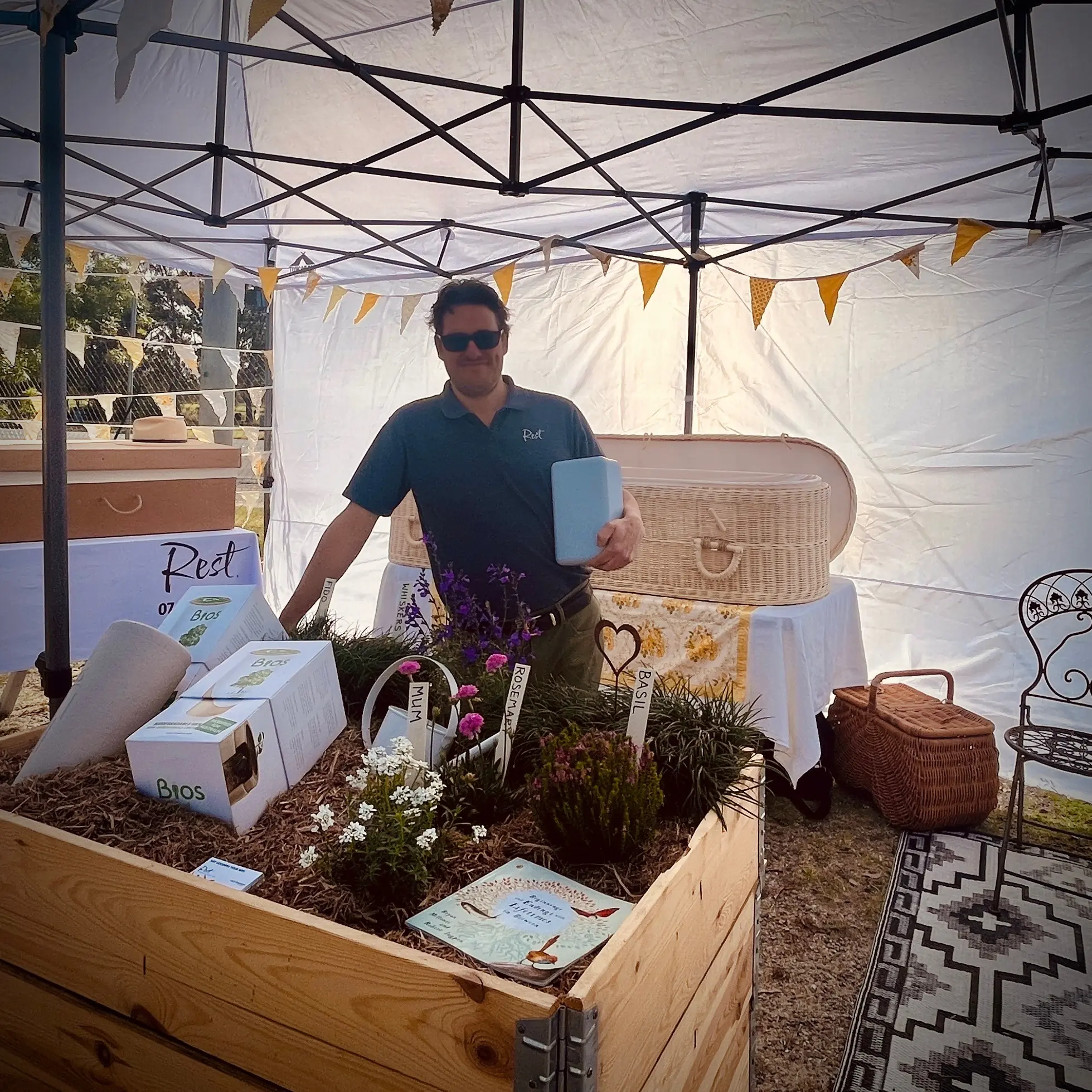
An undertaker can also simply be there to give you the information you need
Why we use the word. At Rest, ‘undertaker’ is the word we like to use for the person doing this work.
We like it because it describes a responsibility rather than a status. An undertaker is someone who has undertaken the care of a person who has died and the arrangements their family needs help with.
Responsibility rather than status.
It also recognises that the work is not necessarily about directing a funeral. And a person may need an undertaker to arrange;
- a simple cremation
- a burial
- a transfer
- a memorial
- or the care of someone who will not have a ceremony at all
Undertaker and funeral director. The terms are often used to mean much the same thing. In Queensland, funeral director also has some legal meaning in legislation and government services sometimes use undertaker and funeral director interchangeably.
At Rest, however, we prefer undertaker because it’s the role we believe we’re in.
We are not necessarily there to direct a funeral.
We’re there to do the work of caring for the deceased person and providing the family with what they need or want.
Ultimately, an undertaker is the person who undertakes the care of someone who has died and the practical work that follows, and sees it through.
Ulls from Rest
Related
- Funeral Director
- Funeral Service Provider
- Funeral
- Memorial
- Burial
- Cremation
Urn
Urn
An urn is a container designed to hold the cremated remains (ashes) of a person after cremation. Urns come in a wide variety of materials, sizes and styles, ranging from simple and practical to highly decorative.
Common materials include:
- Metal such as brass, aluminium and stainless steel
- Wood
- Ceramic or porcelain
- Glass
- Stone or marble
- Biodegradable materials for burial or water scattering
Most adult urns have a capacity of around 3 litres (180–220 cubic inches), although the amount of ashes depends on the person’s size.
An urn is not legally required. After cremation, the ashes simply need to be placed into a secure container. Many funeral providers, particularly those focused on giving families more choice, will supply a standard ashes container and allow families to later transfer the ashes into an urn or another meaningful container they have chosen themselves.
An urn can be used for:
- Keeping ashes at home
- Placement in a memorial niche or columbarium
- Burial in a cemetery or natural burial ground
- Temporary storage before scattering the ashes
- Dividing ashes into multiple smaller keepsake urns for family members
An urn is simply one option. The container itself doesn’t change the significance of the ashes. What matters is choosing something that feels right for the person and their family.
Related
V
VAD
VAD
VAD is the commonly used abbreviation for Voluntary Assisted Dying.
Vigil
Vigil
Vigil is the time spent being present with someone who is actively dying. Family and friends may gather at the bedside to provide comfort, share memories, hold hands, pray, play music, or simply sit quietly together.
A vigil can last for hours or several days and is often a deeply meaningful opportunity to say goodbye in a way that feels right for those involved.
Related
- Dying at home
- End of life
- Palliative Care
- Palliating
Voluntary Assisted Dying
Voluntary Assisted Dying
Voluntary assisted dying (VAD) is a legal end-of-life option that allows an eligible person with an advanced and life-limiting medical condition to choose the timing and circumstances of their death by accessing a prescribed substance intended to bring about their death.
VAD is available in Queensland, where the Voluntary Assisted Dying Act 2021 commenced on 1 January 2023. VAD legislation also operates in every Australian state. The ACT and Northern Territory have different legislative positions.
It is voluntary. A person must make the decision themselves and must be acting voluntarily and without coercion. Nobody else can request VAD on their behalf. The person must also have decision-making capacity in relation to VAD at the relevant stages of the process.
Who can access VAD in Queensland? There are strict eligibility requirements. A person must:
- be 18 years or older;
- have an advanced, progressive disease, illness or medical condition that will cause death;
- be expected to die from that condition within 12 months;
- be experiencing suffering that they consider intolerable;
- have decision-making capacity in relation to VAD;
- be acting voluntarily and without coercion; and
- meet the relevant Australian and Queensland residency requirements.
The person must meet all of the eligibility requirements. Having a serious illness, being elderly, experiencing pain or simply wanting to die is not, by itself, sufficient to access VAD.
VAD is not the same as palliative care. Palliative Care aims to relieve pain, symptoms and distress and improve quality of life. VAD has a different purpose: it involves the administration of a substance with the intention of bringing about the person’s death. A person accessing VAD can continue to receive palliative care and other healthcare.
There is a formal process. VAD cannot simply be requested from a doctor and immediately provided. In Queensland, the process includes a first request, an assessment by a coordinating practitioner, an independent consulting assessment, a second request, a final request and a final review. The person can stop the process at any time before administration.
There are safeguards. The multiple requests and independent assessments are intended to ensure that the person is eligible, understands the decision and is acting voluntarily and without coercion. The process also requires authorised practitioners and specific documentation.
How the substance is administered. In Queensland, self-administration is the default method. The person administers the VAD substance themselves. In circumstances where self-administration is not suitable, the person may choose practitioner administration, where an authorised medical practitioner, nurse practitioner or registered nurse administers the substance at the person’s request.
Where can VAD take place? A person may choose to access VAD in their home or in a facility such as a hospital, hospice or residential aged care facility, subject to the arrangements and requirements applying to that location. The person can express preferences about where they would like to receive the service and where they would like to die.
It is not an advance decision. A person cannot simply put VAD into an Advance Health Directive or other enduring decision and have someone else make the decision later. The person must have decision-making capacity at the relevant stages and personally make the required requests.
After death. Once a person dies following VAD, there are specific legal and administrative requirements. These include notification of the death and the appropriate handling and disposal of any unused VAD substance. The death is dealt with within the Queensland VAD and death-registration framework.
Cause of death. The VAD coordinating practitioner will generally provide the Form 9 — Cause of Death Certificate. This does not mean that the coordinating practitioner needs to be present when the person dies. For example, a person may die at home with a palliative care nurse present, while the coordinating practitioner subsequently completes the Form 9 based on their knowledge of the person’s medical history and the circumstances of the death. Queensland’s VAD framework specifically allows a medical practitioner to certify the death without having seen the person after death, provided they have sufficient information to form an opinion about the probable cause of death.
The underlying illness is recorded as the cause of death. Where VAD has been accessed lawfully, the Form 9 must state that the cause of death was the disease, illness or medical condition that made the person eligible for VAD. It must not refer to voluntary assisted dying as the cause of death. This is important because a person’s usual GP or treating doctor may choose not to participate in VAD. Queensland doctors can conscientiously object to participating in VAD, so the VAD process needs to account for this rather than relying on the person’s usual GP to provide the certificate.
For families and funeral service providers, it is important to understand that VAD is a legally regulated medical process rather than a funeral arrangement. A person may make decisions about their funeral, burial or cremation separately from their VAD decisions. Likewise, a funeral service provider does not provide VAD itself.
VAD therefore provides another legally regulated end-of-life choice for eligible people who are approaching death and experiencing suffering they consider intolerable, while maintaining the person’s autonomy and requiring a formal process of assessment and safeguards.
Related
W
Wake
Wake
A wake is a gathering held after someone has died, traditionally involving family and friends coming together to spend time with the person who has died and with each other. In Australia, the word is now most commonly used to describe the gathering that takes place after a funeral or graveside ceremony.
The traditional wake. The word wake has a long history in Western funeral traditions. In the traditional Irish wake, for example, the person who has died would remain at home, often for a period of time before the funeral, while family, friends and members of the community gathered around them. People might pray, tell stories, share food and drink, keep the person company and spend time together before the funeral and burial.
The person was present. Traditionally, a wake was associated with keeping watch over the person who had died. This is one of the origins of the word and is closely related to the idea of a Vigil.
The Australian meaning. In contemporary Australia, wake generally means something different. It most often refers to the gathering held after the funeral, particularly after a Graveside or cremation service. The person who has died is usually not present.
A place to gather. A wake might be held at a pub, club, restaurant, community hall, private home, garden or other venue. Food and drinks are commonly provided, and people may spend time talking, sharing stories and remembering the person in a less formal environment than the funeral itself.
It can be part of the farewell. Although the wake happens after the formal funeral ceremony, it can be just as important to the people attending. The funeral provides a structured opportunity to acknowledge the death and say goodbye; the wake provides time to relax, reconnect, tell stories and support one another.
Not necessarily solemn. A wake can be quiet and reflective, but it can also be lively and celebratory. Laughter, music, food, drinks and stories are all perfectly consistent with a wake. The atmosphere often reflects the personality of the person who has died and the relationships they had with those around them.
Wake, funeral and memorial. A Funeral is held with the person who has died present. A Memorial is held without the coffin or casket present. A wake is generally a gathering after the funeral, although the traditional meaning of the word was quite different.
A wake is ultimately time set aside for people to be together after someone has died. To talk, remember, support one another and, often, celebrate the life of the person they have just farewelled.
Related
Water Cremation
Water Cremation
Water cremation is another term used to describe Alkaline Hydrolysis.
See Alkaline Hydrolysis.